- 1 EIGHTEENTH-CENTURY HOMES AND SHOPS
- 2 A SECRET OASIS IN THE HEART OF THE EIXAMPLE
- 3 AIR-RAID SHELTERS
- 4 AN ANTI-AIRCRAFT BATTERY
- 5 A FORMER PRISON OPEN TO THE PUBLIC
- 6 A NINETEENTH-CENTURY FACTORY
- 7 A COLLECTION OF HEARSES
- 8 A BOOKSHOP LINKED TO A BESTSELLER
- 9 AN OPEN-AIR DOLL’S HOUSE
- 10 ALLOTMENTS IN THE HEART OF THE CITY
Let’s be honest: if you’re planning your first 2-day break in Barcelona, we know full well that your priority will be to see the Sagrada Família, the Gothic Quarter, Montjuïc, and the other big tourist spots dotted around the Catalan capital, right? But what happens when it isn’t your first visit to the City of Counts? If that’s you, you’ll most likely want to discover unusual places to visit in Barcelona. And we can assure you there are plenty.
Make the most of your time in one of the world’s most popular destinations to discover truly unique spots that would be very hard to find in any other city on the planet. Hard to believe? Not at all. Here’s a top 10 of one-of-a-kind places that won’t leave you indifferent. And if you’re still looking for apartments in Barcelona for your stay, at the end we’ll tell you where to stay just a stone’s throw from the sea. Take note!
EIGHTEENTH-CENTURY HOMES AND SHOPS
We begin our tour of unusual Barcelona with an archaeological site that has no equal in Europe: El Born, now part of the Barcelona History Museum (MUHBA). You’ll find it in the former Born market building (1876), one of the city’s finest examples of iron architecture. Inside is an archaeological site covering part of the early 18th-century La Ribera neighbourhood, which was razed to build a military citadel. It also remembers the final moments of the War of the Spanish Succession, on 11 September 1714, and what the conflict meant for Barcelona and Catalonia. The personal belongings recovered in the area also help visitors understand what everyday life was like in those turbulent years.
Entry to the building at Plaça Comercial, 12, is free, while the exhibitions cost €3 (or €4.50 for a combined ticket). If you’d like to wander among the houses, bars, distilleries and other buildings of the period, we recommend the guided tour of the site, “Barcelona 1700”, for €6. The centre opens Tuesday to Sunday and closes on Mondays that aren’t public holidays. If you’re staying in one of our apartments in Poblenou, it’s just a few stops away on metro line 4 (Jaume I station).

A SECRET OASIS IN THE HEART OF THE EIXAMPLE
Beyond Barcelona’s 10 urban beaches, with full facilities and excellent public transport links, the heart of the Eixample hides one of its most surprising inner-block courtyards. We’re talking about the Torre de les Aigües gardens, at Carrer de Roger de Llúria, 56. It’s a courtyard dominated by an old water tower that looks like something from another era.
For years, its swimming pool with a sandy area for children was known as the “Eixample beach”. It’s currently closed and, for now, there’s no confirmed reopening date. Even so, the gardens open every day, from 8.30 am to 9 pm in summer and until 7 pm in winter. It’s an ideal stop if your short-stay apartment plans in Barcelona leave you little time and you fancy a rest right in the city centre. If you’re after a dip, take a look at this article on the 8 best outdoor swimming pools in Barcelona.

AIR-RAID SHELTERS
During the Civil War (1936–1939), Barcelona was one of the first major European cities to suffer systematic aerial bombing of its civilian population. To protect themselves, its residents dug a huge network of underground tunnels. In total, the city had as many as 1,322 air-raid shelters, some of which can still be visited today.
One of the best-known is Shelter 307 (Nou de la Rambla, 175), in the Poble-sec neighbourhood. Around 400 m of tunnels were planned, although only about 200 m had been dug by the end of the war. They are 2.1 m high and between 1.5 and 2 m wide. The shelter had a fountain, toilets, an infirmary, a children’s area and a fireplace, and it was built by the local residents themselves. Today you can visit it on a guided tour on Saturdays and Sundays for €3.50, booking required.
Another air-raid shelter open to the public lies beneath Plaça del Diamant, in Gràcia. It was discovered in 1992 during building works, lies 12 m underground, and was one of the more than 90 shelters the neighbourhood once had. At the time, Gràcia was a heavily industrialised area, which made it a priority military target.
The Taller d’Història de Gràcia association runs guided tours every Sunday at 11 am for €3, booking required. Tours are in Catalan, except on the second Sunday of each month, when they’re in Spanish.

AN ANTI-AIRCRAFT BATTERY
We stay with the Civil War, as this grim chapter has left us another place well worth discovering: the remains of an anti-aircraft battery. It stands at the top of the Turó de la Rovira, in the El Carmel neighbourhood, and was built to defend the city from air raids, most of them carried out by the Italian fascist air force. When the war ended, the guns were removed, and the so-called barri dels Canons grew up here. It was one of Barcelona’s last shanty towns and held out until 1990.
You can get there on buses 22 and 119 and walk for a few minutes, or head to Plaça del Nen de la Rutlla and walk up through the lovely Parc del Guinardó. The outdoor area is free but closes at night: at 7.30 pm in summer and 5.30 pm in winter. The MUHBA exhibition spaces open on Wednesdays, Fridays, Saturdays and Sundays. By the way, the Carmel bunkers are one of the best viewpoints in Barcelona. From here you can see the whole city, from the Sagrada Família to the Poblenou coastline, home to our holiday apartments in Barcelona. That said, please be respectful of the residents when you visit.

A FORMER PRISON OPEN TO THE PUBLIC
From its opening in 1904 until its closure on 8 June 2017, the Barcelona Men’s Prison, known as La Modelo, played a key role in the recent history of the Catalan capital. Building work began in 1887, and it was meant to be a model for prisons across Spain, hence its name. Thousands of people passed through its cells, many of them locked up for political reasons or even for their sexual orientation under the Franco dictatorship. It was here, on 2 March 1974, that Salvador Puig Antich was executed. He and Heinz Chez, who was executed the same day in Tarragona, were the last two people put to death by garrote in Spain.
Today, La Model can be visited free of charge on one-hour guided tours, booking required. From Monday to Friday there are tours at 5 pm (in Catalan) and 5.30 pm (in Spanish). On Saturdays there are tours at 11 am, 11.30 am, 5 pm and 5.30 pm, and on Sundays at 10.30 am and 12 pm. Please note there are no tours on public holidays or during August.

A NINETEENTH-CENTURY FACTORY
Catalonia was one of the first regions in southern Europe to industrialise. Would you like to step inside a factory from this period? If so, head to the Anís del Mono factory. It makes a popular aniseed liqueur that has been a fixture in Catalan homes for more than a century and a half.
Brothers Josep and Vicenç Bosch founded it in 1870, and the industrial complex still has its distillation room, with its copper stills, as well as Modernista spaces such as the director’s office and the archive. Although bottling moved to Andalusia in 2021, the distilling is still done here. As you explore the premises, you’ll discover how anisette and other historic drinks, such as Aromas de Montserrat, were made.
The Museu de Badalona runs guided tours on the third Sunday of every month. They last an hour and a half and cost €5.93, and children under 7 go free. Tickets are sold on the museum’s website, with a maximum of four per purchase. If you have any questions, you can call (+34) 93 384 17 50. The factory is at Carrer d’Eduard Maristany, 115, in neighbouring Badalona, just a few kilometres from Poblenou. It makes a perfect day out if you’re staying in weekly apartments and have time to venture a little beyond the city.

A COLLECTION OF HEARSES
It may be an uncomfortable subject, but death is part of every era and culture. How about finding out how people said goodbye to the dead in the past? For that, we suggest visiting the Barcelona Cemeteries Hearse Collection, next to Montjuïc cemetery. There you’ll find 13 hearses, six carriages that took families to the church and cemetery, and three motor vehicles. There are also decorative pieces and the parts that kept them running. Entry is free, and it opens on Saturdays, Sundays and 1 November, from 10 am to 2 pm, at Carrer de la Mare de Déu de Port, 56–58.

A BOOKSHOP LINKED TO A BESTSELLER
Among the most popular themed routes in Barcelona is the one that follows the settings of The Shadow of the Wind, by Carlos Ruiz Zafón, one of the great fiction phenomena of the 21st century. So if you’d like to visit a bookshop closely linked to this novel and to the other three books in The Cemetery of Forgotten Books series, we have the answer.
It’s the legendary Librería Canuda, which dates back to 14 April 1931 (the same day the Second Republic was proclaimed), when it opened on Carrer dels Tallers, in El Raval. Years later, it moved to Carrer de la Canuda, in the Gothic Quarter, where it built up a stock of more than 200,000 books, some of them genuine rarities. That historic shop closed in 2013, but its legacy lives on at the Kepos-Canuda bookshop, at Carrer del Pare Laínez, 36, in Gràcia, a paradise for second-hand book lovers.

AN OPEN-AIR DOLL’S HOUSE
Feel like a child again at the Caseta de Nines del Putxet, at Carrer de la Costa, 79–81, next to the Mercè Rodoreda Gardens. It’s a small house built in the 20th century to look like a Modernista villa. Its façade is covered in trencadís mosaic and tiles that tell the story of Hansel and Gretel. The City Council restored it in 2026, and although it only opens on special occasions, you can see it perfectly well from the garden steps. If you’re travelling with children, we guarantee this is one of the unusual places in Barcelona they’ll enjoy most. And if you’re looking for apartments to rent in Barcelona with room for the whole family, we give you a few ideas at the end of the article. Give it a try!

ALLOTMENTS IN THE HEART OF THE CITY
It may be hard to believe, but you can travel to rural Catalonia without leaving Barcelona. Just head to La Clota, the city’s smallest neighbourhood, in the Horta-Guinardó district.
Once there, we suggest strolling along streets such as Alarcón, Capcir and Lisboa and along the Camí de Sant Genís a Horta, where time seems to have stood still. You’ll find traditional buildings, low houses with small vegetable gardens where residents still grow their own fruit and veg, wells and old washhouses. Its lookout tower also stands out, a reminder of the days when this area was open countryside. But don’t leave it too long. The neighbourhood is part of an urban development plan that protects its historic core but will transform much of the area around it.
To get there, take the metro to Vall d’Hebron station (L3 and L5) or buses 27, 112 or 185. It’s one of those places best enjoyed at a leisurely pace, which you’ll appreciate if you’re on a longer stay in mid-stay apartments in Barcelona.
That wraps up our list of unusual places to visit in Barcelona, which is sure to come in handy if you visit the Catalan capital often. Even so, we’d be delighted if you helped us add to these suggestions. Fancy sharing your recommendations with us? And if you’re looking for comfortable accommodation to set out from and discover all these places, read on.

MORE INTERESTING STUFF
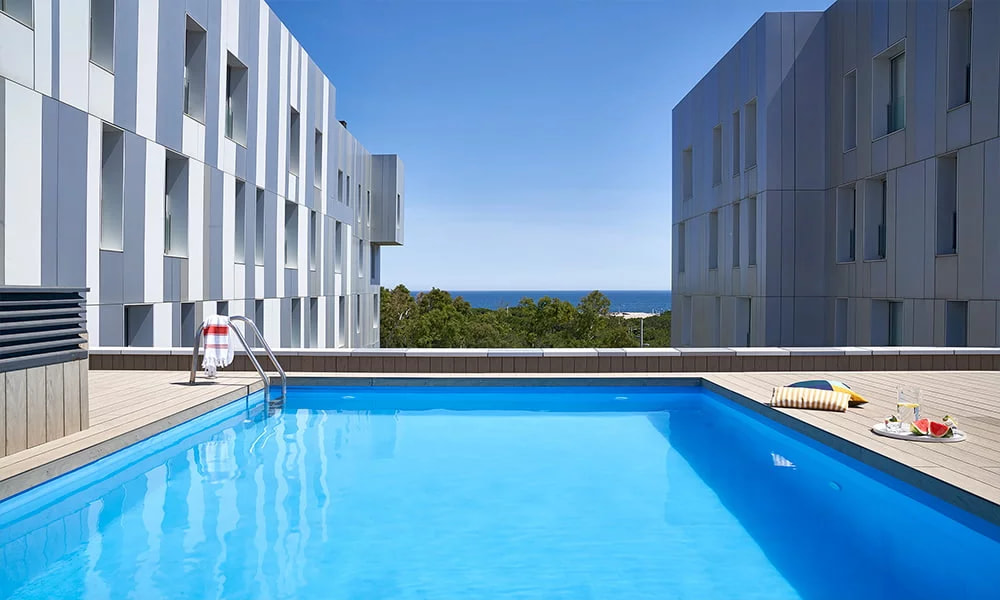
Holiday apartments by the beach in Barcelona
Since 2010, Lugaris Apartaments has been offering you the best holiday rental flats in Barcelona, perfect for a family holiday, with friends or as a couple, or for medium-term stays.
You can choose between apartments near the beach in Barcelona, at Lugaris Beach, with sea views, 2 swimming pools (one for adults and one for children) and capacity for up to 6 people, and the Lugaris Rambla flats, located on the Rambla de Poblenou and just 300 m from Bogatell beach, with a balcony or terrace of up to 22 m2 and ideal for couples or families and groups of up to 5 people. All our luxury flats in Barcelona are air-conditioned and equipped with all the appliances, furniture and bed linen you will need during your stay. They also have satellite TV and free high-speed Wi-Fi connection, as well as a safe and a 24-hour private security service.
What’s more, when you make your booking, you can reserve many other additional services: international press in your flat, parking space, transfer service to and from Barcelona airport, bicycle hire, supermarket shopping, museum, sports and show tickets, babysitting service and much more.
For more information, contact Lugaris Apartments without obligation.